
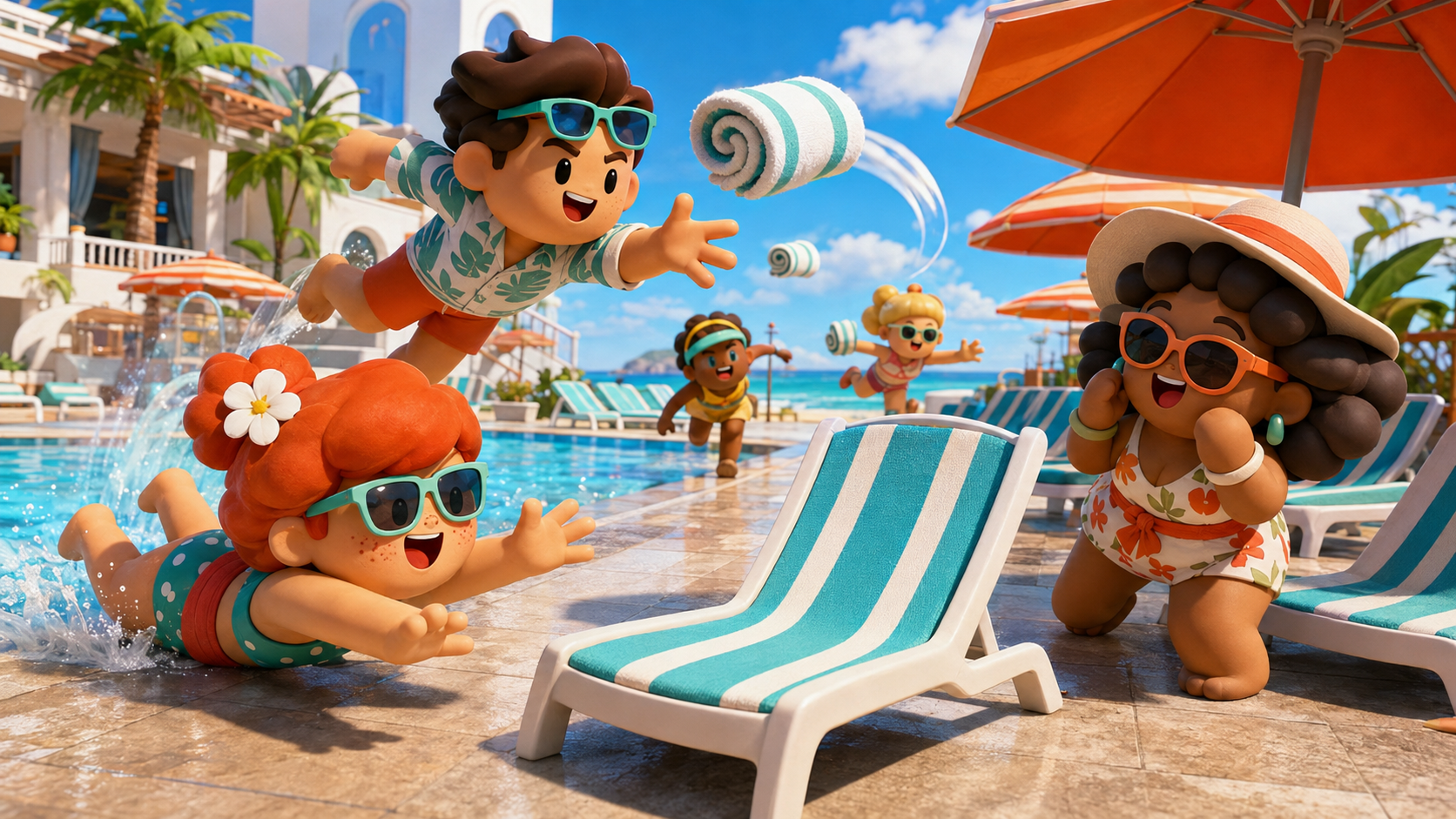
Beach Chair Rumble started with a small, instantly recognisable frustration: everybody wants the best place by the pool, and somehow every good lounger already has a towel on it.
The first concept was broader and calmer. Players would manage a family holiday, balancing different wishes around the resort. One person might want the pool, another the bar, a quiet lounge area or reliable Wi-Fi. Happiness came from reading those needs and planning the day well.
The towel that changed the game
The breakthrough came when towels stopped being decoration and became a rule. A towel could claim a chair—but it could also be carried, thrown and used to interfere with somebody else’s perfect plan. That one object connected the holiday theme to a much more physical, readable kind of play.
The idea shifted from managing the resort at a distance to running through it with three other players. Towel dispensers became resupply points, loungers became contested territory and every short trip across the pool deck created a chance for a plan to go gloriously wrong.
The best version was not about owning every chair. It was about the story of how your sensible plan fell apart on the way there.
Guests needed plans of their own
To make the resort feel alive, we began building autonomous guest behaviour. Guests can look for a towel dispenser, collect a towel, choose an available chair, travel to it, place the towel and settle down. Chair reservations and occupancy rules keep several guests from choosing the same destination, while pathing and stuck recovery help the sequence survive a busy play space.
This work turned a static level into a changing problem. The best chair might be open when a player starts moving and occupied by the time they arrive. The resort is no longer a backdrop; it is a system that keeps making new situations.
Making four-player chaos readable
A local party game has to communicate quickly. We explored a four-player HUD and a family of simple icons for towel supply, carrying capacity, dashing and the different resort areas. The goal is to let players understand their next useful move without draining the humour from the screen.
At the same time, the resort grew around the mechanics: pool and lounge zones, a bar, cabanas, radio and noise areas, parasols, waste, and a water slide. Each addition is being judged by the same question: does it create a clearer choice or a better story between players?
Where the prototype stands
Built, explored and still uncertain.
Towel collection and chair claiming, autonomous guest-to-chair behaviour, reservation logic, core movement experiments and the four-player interface direction.
The final scoring structure, how strongly family priorities should influence a round, pacing, catch-up opportunities and the right balance between tactics and joyful disruption.
What we are chasing
Beach Chair Rumble is still in development, and its final shape is not locked. What has become clear is the feeling we want: a game that is welcoming at a glance, immediately funny with friends, and full of small decisions that make every round feel like its own holiday disaster.
The next steps are less about adding everything and more about finding the strongest version of what is already there—one where the plan matters, the panic is earned and losing can still create the best story of the evening.
Explore Beach Chair Rumble